

The IP protection rating is a two-digit coding system defined by the IEC 60529 standard that indicates how well electrical equipment is protected against solid objects and water. The first digit refers to protection against dust and solid-object ingress, while the second digit indicates protection against water ingress. The higher the digit, the higher the protection level. For example, in an IP65 rating, 6 means the enclosure is completely dust-tight, while 5 means it withstands low-pressure water jets.
In gearbox and motor selection, this code often remains just a line in a catalogue; however, field failure records show that an unsuitable protection rating for the operating environment is one of the main causes of shortened equipment life. An IP54 motor in a cement plant, an enclosure that cannot withstand washdown on a food line, or a gearbox with an incorrectly positioned breather outdoors can fail quickly even when it has been sized correctly from a technical standpoint. Below, we explain how to read the code, what the common ratings mean, and which level is required in different operating environments.
What Is an IP Protection Rating?
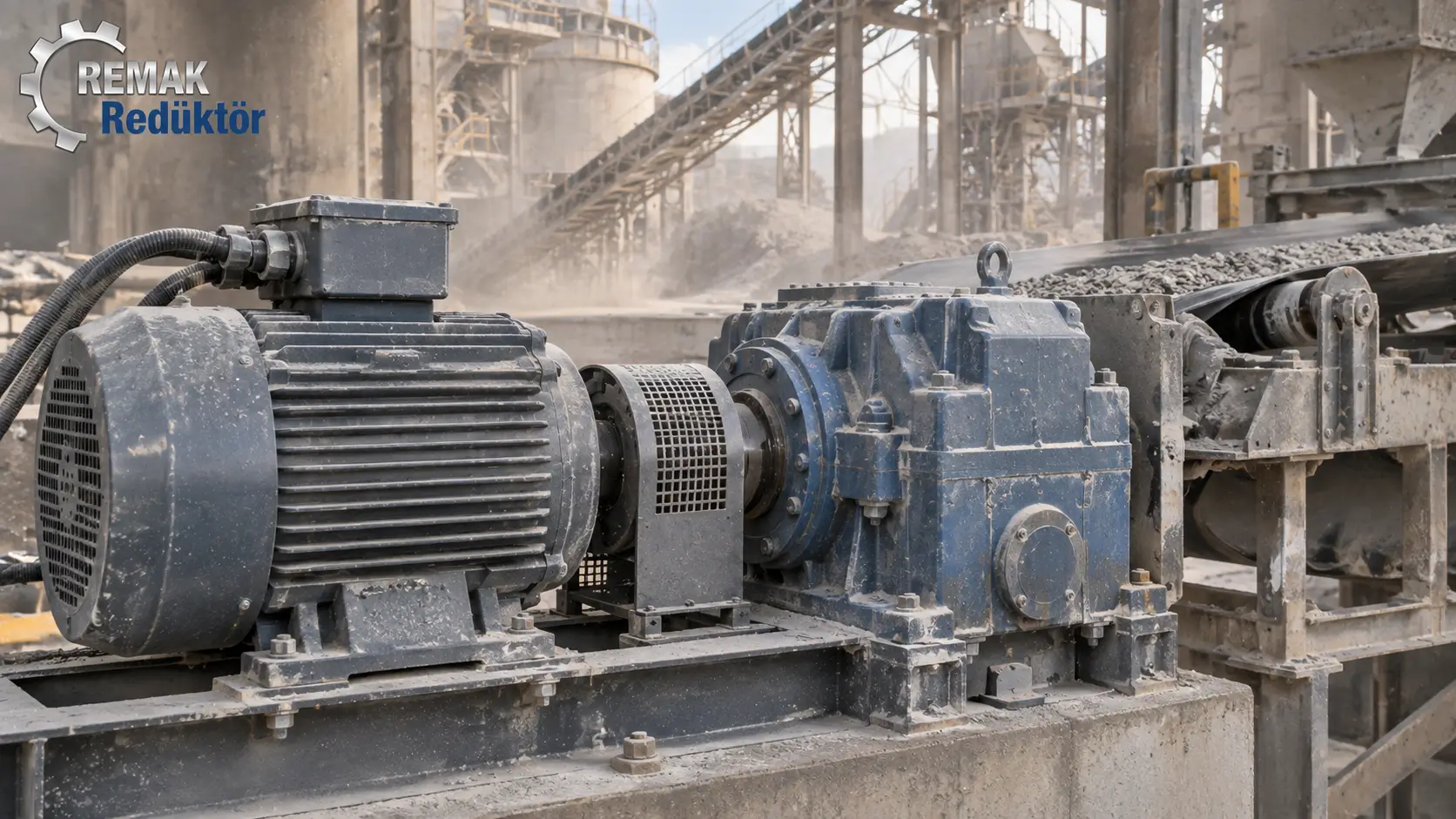
IP is the abbreviation of the English term Ingress Protection meaning "ingress protection". It describes, in a standardised way, the protection an enclosure provides against unwanted substances entering from outside. The purpose is twofold: to prevent damage to electrical components inside and to prevent people from touching hazardous parts.
The structure of the code is fixed: IP letters followed by two digits. Some products may have additional letters after these two digits; in industrial drive equipment, the most common is the letter K, which indicates high-pressure washdown.
Knowing what the IP code does not describe is just as important as knowing what it does. This code;
- Does not indicate resistance to mechanical impact; impact resistance is expressed by a separate code (IK).
- Does not cover resistance to corrosion, chemical attack or UV exposure.
- Does not provide information about the thermal behaviour of the equipment. A closed and sealed enclosure also retains heat; therefore, when selecting a high IP rating, cooling must be evaluated separately. We cover this subject in detail on our cooling page.
How Is the IP Code Read?
The two digits are evaluated independently. A high dust-protection rating does not mean that water protection is also high. The table below shows the meaning of both digits:
| Digit | 1st digit — protection against solid objects and dust | 2nd digit — protection against water |
|---|---|---|
| 0 | No protection | No protection |
| 1 | Objects 50 mm and larger (back-of-hand contact) | Vertically falling water drops |
| 2 | Objects 12.5 mm and larger (finger) | Dripping water at up to 15° tilt |
| 3 | Objects 2.5 mm and larger (tool, thick wire) | Water sprayed up to 60° (rain) |
| 4 | Objects 1 mm and larger (thin wire, screw) | Water splashing from any direction |
| 5 | Limited dust ingress, not enough to interfere with operation | Low-pressure water jet |
| 6 | Completely dust-tight | Powerful water jet |
| 7 | — | Temporary immersion at 1 metre (30 minutes) |
| 8 | — | Continuous immersion; conditions specified by the manufacturer |
| 9 | — | High-pressure, high-temperature water jet |
A critical detail: protection levels are not always cumulative. Values 7 and 8 in the second digit describe immersion, while 5 and 6 describe pressurised water jets, and these are different test methods. An IP67 enclosure may not leak when immersed in water but may not provide protection when washed with a high-pressure hose. In applications where both conditions exist, the equipment must be certified with dual ratings such as IP67 and IP69K.
IP Protection Rating Table
The most common ratings for industrial gearboxes and motors, together with their meanings, are shown below:
| IP rating | Dust protection | Water protection | Typical use |
|---|---|---|---|
| IP54 | Limited dust ingress | Water splashing from any direction | Enclosed production halls, machine rooms, workshops |
| IP55 | Limited dust ingress | Low-pressure water jet | Enclosed areas occasionally cleaned with a hose |
| IP65 | Completely dust-tight | Low-pressure water jet | Dusty production environments, sheltered outdoor installation |
| IP66 | Completely dust-tight | Powerful water jet | Outdoor sites, coastal areas, washdown lines |
| IP67 | Completely dust-tight | Resistant to temporary immersion | Pits and channel installations with flooding risk |
| IP68 | Completely dust-tight | Resistant to continuous immersion | Special applications that remain continuously underwater |
Which IP Rating Is Required for Gearboxes and Motors?
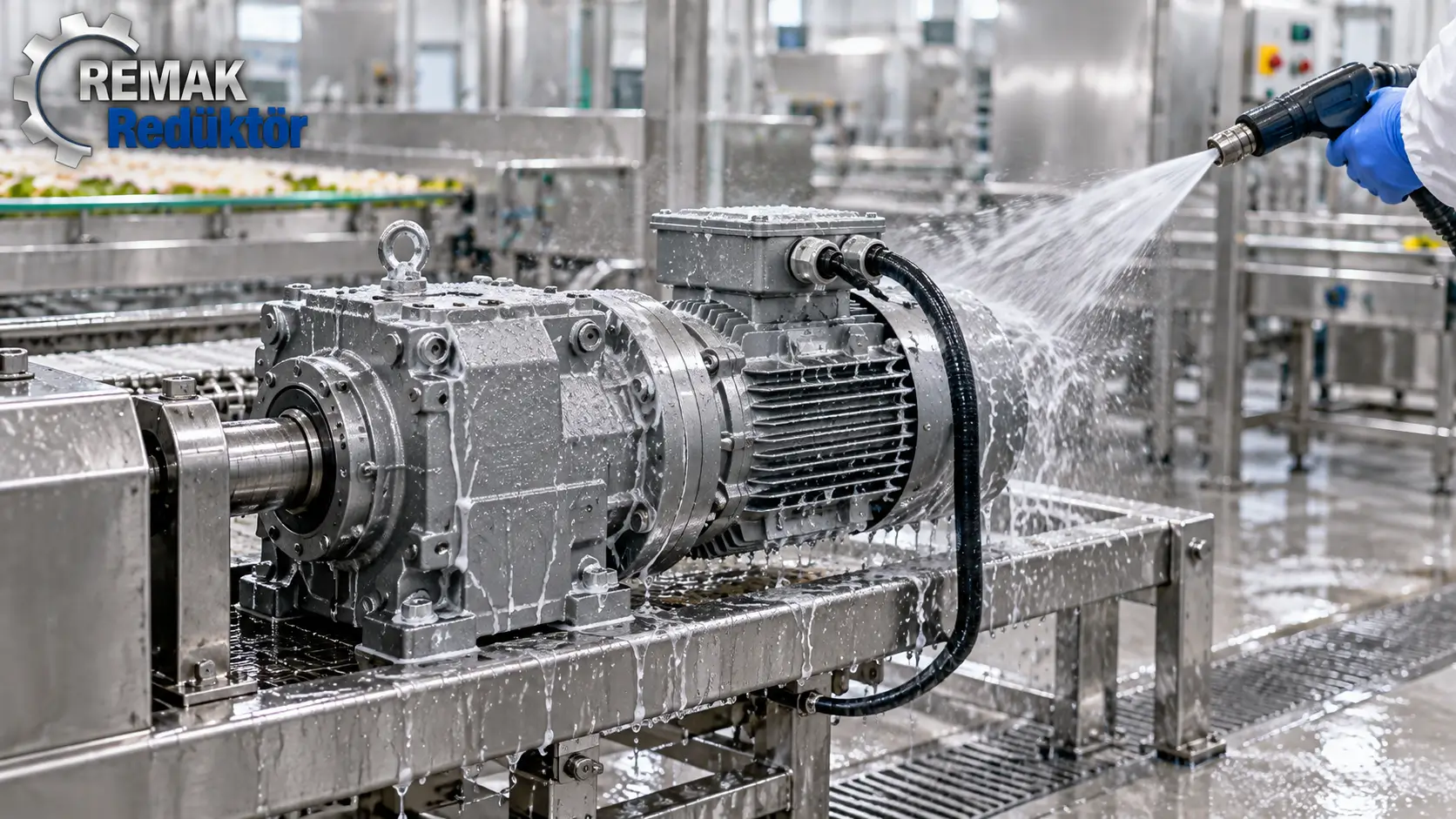
The correct rating is determined by defining the actual conditions the equipment will encounter. The amount of dust in the environment, the cleaning method, whether the equipment is exposed to rain, and the possibility of standing water are the four basic questions.
Enclosed and clean production environments. In assembly lines and machine rooms where temperature is controlled and dust levels are low, IP54 is sufficient for most applications. In these environments, selecting an unnecessarily high protection rating can create problems rather than benefits because it makes heat dissipation more difficult.
Heavily dusty environments. Cement, mining, lime and aggregate plants require a first digit of 6 because the dust is fine and abrasive. IP5X ratings, which allow limited dust ingress, are insufficient in these environments; fine dust that penetrates the enclosure gradually wears seal surfaces and degrades bearing lubrication. In these plants, IP65 is the minimum level.
Washdown lines. Beverage and food production equipment is cleaned with pressurised water and chemicals at the end of every shift. Water protection is the determining factor here: IP66 is generally required, while IP69K is expected on lines using high-pressure and hot water.
Outdoor and exposed environments. Agricultural machines, dam gate systems and facilities operating outdoors should use IP65 as the minimum level, with IP66 as the safer choice. It is also important to note that the IP code alone is not sufficient outdoors; an enclosure that heats up during the day and cools at night experiences pressure changes, and this cycle draws moisture inside. Therefore, the type and position of the breather, paint class and seal type must also be planned for outdoor installation.
Locations with a risk of standing water. In underground channels, pump pits or locations with a flooding risk, the equipment may be temporarily submerged. IP67 is required in this scenario.
A frequently confused point should be clarified here: in a drive unit, the IP rating is usually declared for the motor. In a gearbox housing, the primary elements that provide protection are the seals at shaft outputs, gasket surfaces and the breather. As environmental conditions become more severe, solutions such as double-lip seals, protective covers or special seal materials are used; for more detail, see our sealing page. For the relationship between motor protection rating, enclosure type and cooling method, our motors page provides guidance.
The protection rating is not a parameter considered in isolation during selection; it must be evaluated together with power, gear ratio, service factor and operating duty. You can find the selection approach covering all these parameters on our gearbox calculation page.
Let’s Determine the Right Solution for Your Environmental Conditions
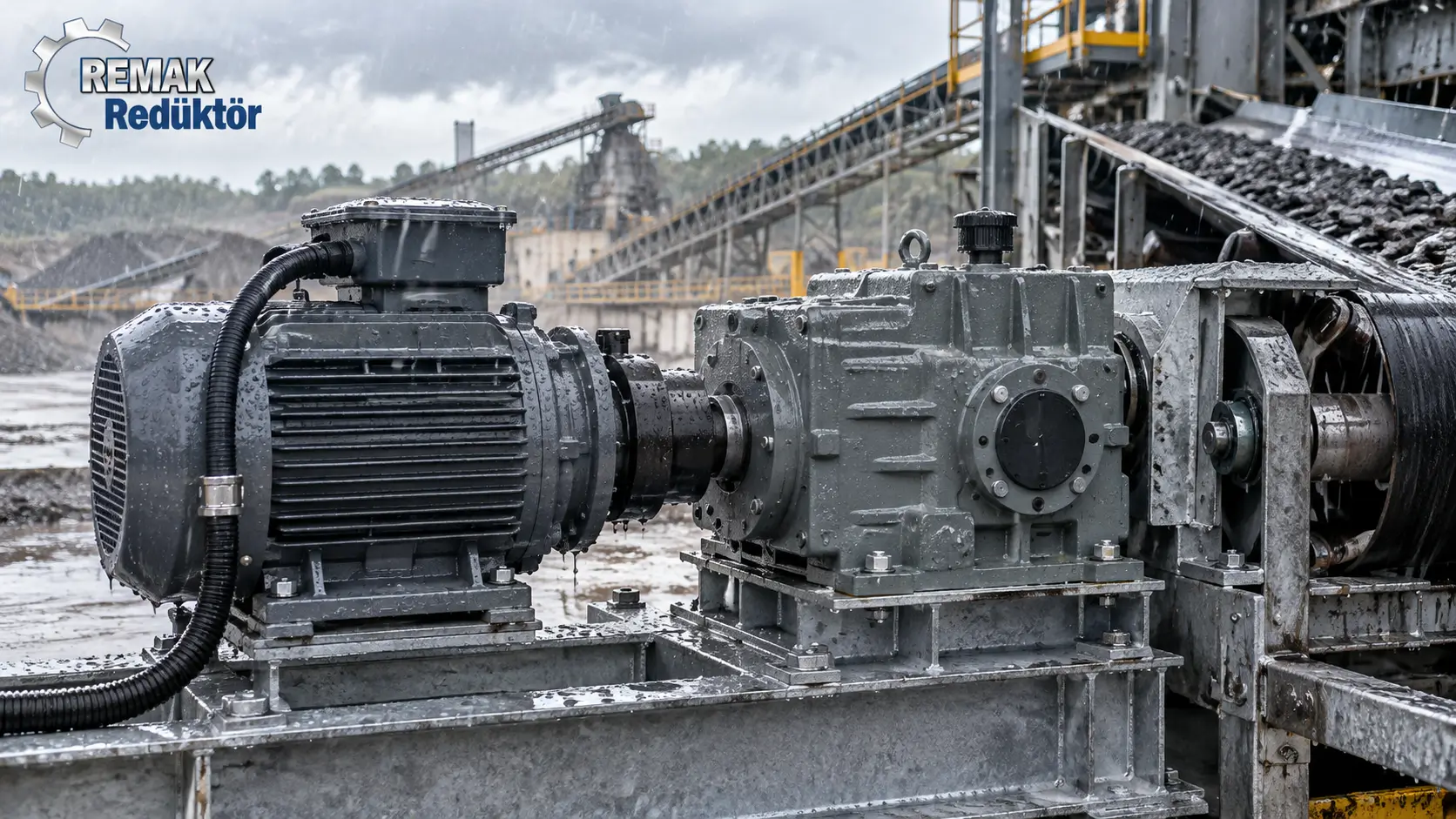
In a significant proportion of gearboxes and motors that fail prematurely in the field, the problem is not the calculation but an incomplete description of the environmental conditions. When the type of dust, cleaning method, ambient temperature and mounting location are correctly specified from the outset, the protection rating and sealing solution can be designed accordingly.
As Remak Redüktör, a manufacturer of gearboxes and gear units since 1987, we can jointly determine the protection rating, seal configuration and surface protection suitable for your operating environment according to the requirements of your application. You can review our product families and contact us through our contact page to share the technical details of your project.

Frequently Asked Questions About IP Protection Ratings
What is the difference between IP54 and IP65?
The difference is present in both digits. IP54 allows limited dust ingress; a small amount of dust may enter, provided it does not interfere with operation. IP65, however, is completely dust-tight. On the water side, IP54 withstands splashing only, while IP65 withstands low-pressure water jets. In practice, this means that in an environment with continuous fine dust, IP54 equipment can experience seal and bearing wear over time, whereas IP65 equipment is protected. In clean indoor environments, IP54 is sufficient, so moving to IP65 provides no additional benefit.
Which IP rating should be selected for a gearbox operating outdoors?
For drive units operating outdoors, IP65 is the minimum level, while IP66 is appropriate where equipment is directly exposed to rain and washdown. However, the IP code alone is not a sufficient criterion outdoors. An enclosure that heats during the day and cools at night experiences pressure changes, and this breathing effect draws moisture inside, resulting in water accumulation in the oil and corrosion. Therefore, the breather type and position, the temperature range of the seal material, the corrosion class of the housing coating, and any required protective cover must be planned together.
Is IP67 sufficient in a dusty environment?
It is sufficient in terms of dust protection because the first digit, 6, means the enclosure is completely dust-tight. The point requiring attention is water protection: IP67 is certified by an immersion test, not a pressurised water-jet test. In an environment that is both dusty and washed with pressurised water, IP67 alone does not provide assurance; the equipment should also be certified to IP66 or IP69K.
Are IP protection rating and sealing the same thing?
They are not the same and, in many cases, they describe opposite directions. An IP rating refers to preventing ingress from outside to inside, namely keeping dust and water from reaching the equipment. In gearboxes, sealing largely concerns preventing leakage from inside to outside, namely keeping oil from escaping. The two concepts intersect at shaft seals; the same seal both retains oil and prevents external contamination from entering. Therefore, even if equipment has a high IP rating, oil leakage can occur if the seal type is not suitable for the application.
What is IP69K and how does it differ from IP68?
IP69K indicates resistance to close-range washdown with high-pressure, high-temperature water. The test is performed by spraying water at approximately 80 °C and high pressure from different angles. IP68, by contrast, is based on depth rather than pressure and describes the ability of equipment to remain continuously submerged. In other words, an IP68 enclosure may be immersed in water but may not withstand a steam-cleaning gun. IP69K is the rating typically required in areas with intensive daily cleaning, such as food and beverage production lines.
What does the letter X mean in an IP code?
The letter X indicates that no test was carried out or no value was declared for that digit; it does not mean there is no protection. For example, IPX7 means that the product's water protection has been certified, but no separate test has been declared for dust protection. In industrial equipment selection, it is preferable for both digits to be declared numerically; when a code contains X, clarification should be requested from the manufacturer for the unspecified digit.
