

Torque is a physical quantity that measures the rotational effect of a force and is based on a very simple formula: τ = F × r. In this formula, τ (tau) represents the torque value, F is the applied force, and r is the perpendicular distance to the axis of rotation. Its unit is accepted as Newton-meter (N·m). For example, if you apply a force of 100 Newtons with a wrench that is 50 cm long, the torque value you obtain will be 0.5 m × 100 N = 50 N·m.
In daily life, you constantly encounter the principle of torque without realizing it. When pushing a door handle, tightening a screw, turning a steering wheel, or pressing a bicycle pedal, you are actually producing torque. In engineering applications, however, this concept plays a much more critical role. From motor design to bridge construction, from robotic systems to the automotive industry, accurate torque calculations are vital in many fields.
The most important point to consider when making calculations is the angle at which the force is applied. Maximum torque is obtained when the force is applied perpendicular to the lever arm. When the angle changes, the formula becomes τ = F × r × sin(θ). Therefore, when loosening a bolt, keeping the wrench as perpendicular as possible will make your job easier. In the following sections, we will reinforce these calculations step by step through different scenarios.
What Is Torque and Why Is It Important?
Torque is one of the fundamental quantities in physics and engineering that defines the rotational effect of a force. It is expressed as the product of the force applied to rotate an object around a specific axis and the distance of the application point from that axis. In everyday language, it is also referred to as "rotational force" or "twisting moment." When turning a door handle, opening a bottle cap, or tightening a screw, you unconsciously make use of this principle.
The concept of torque has an indispensable place in engineering disciplines. Determining the correct torque values is critical in a wide range of areas, from motor design to machine elements, from robotic systems to the aerospace industry. Especially in the automotive industry, a vehicle’s acceleration performance, climbing ability, and load-carrying capacity are directly related to engine torque. Insufficient torque values prevent systems from operating efficiently, while excessive torque can cause damage to mechanical components.
In daily life, understanding torque helps you produce practical solutions. You have likely experienced that using a long-handled wrench makes it easier to loosen a bolt. This is because increasing the lever length allows you to generate higher torque with the same force. Similarly, door handles are placed at the farthest point from the hinges as an architectural application of this principle. Understanding torque makes it easier to both comprehend technical problems and complete everyday tasks with less effort.
Torque Formula and Units
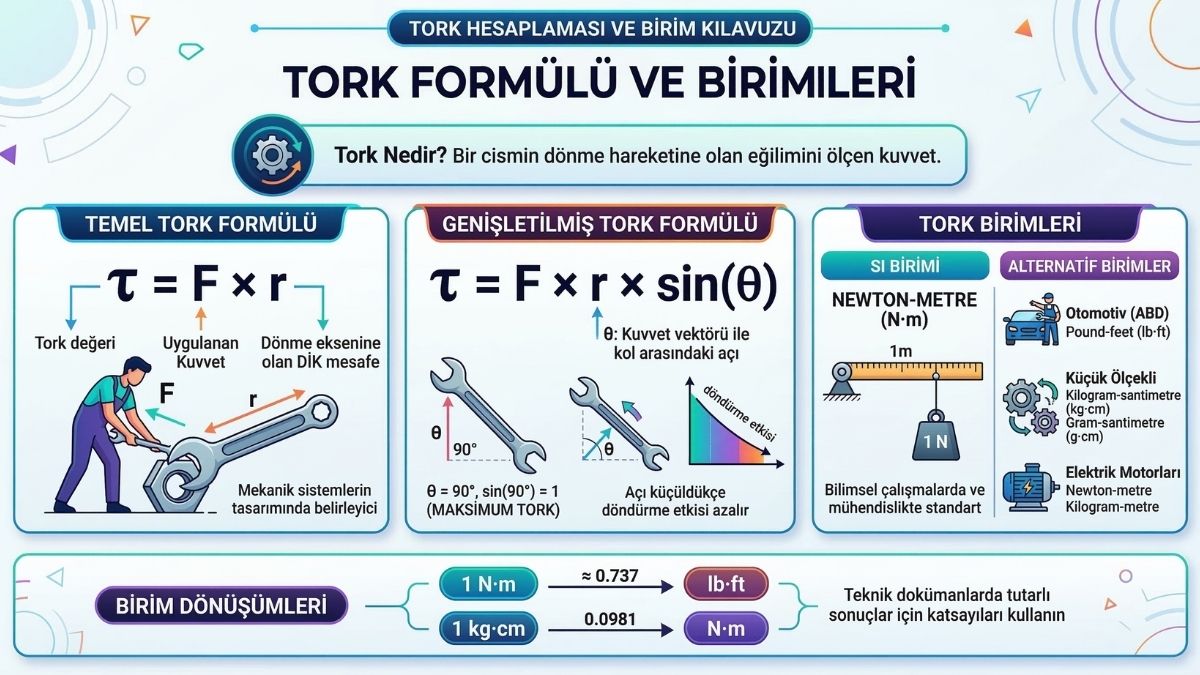
The basic formula used in torque calculation is expressed as τ = F × r. In this equation, τ (tau) represents the torque value, F is the applied force, and r represents the perpendicular distance from the point of force application to the axis of rotation. Although the formula appears quite simple, it plays a decisive role in the design of mechanical systems.
In cases where the force is not applied perpendicular to the lever arm, the extended form of the formula is used: τ = F × r × sin(θ). Here, θ represents the angle between the force vector and the lever arm. When the angle is 90 degrees, the sine value becomes 1, resulting in maximum torque. As the angle decreases, the rotational effect decreases proportionally.
In the International System of Units (SI), the unit of torque is accepted as Newton-meter and is expressed as N·m. This unit represents the rotational moment generated when a force of one Newton is applied to a lever one meter long. It is the standard unit used in scientific studies and engineering calculations.
Different industries and regions commonly use alternative units. In the automotive industry, especially in the American market, the pound-foot (lb·ft) unit is frequently encountered. In smaller-scale applications, kilogram-centimeter (kg·cm) or gram-centimeter (g·cm) units are preferred. Electric motor catalogs usually include values in Newton-meter or kilogram-meter.
Knowing certain conversion factors makes it easier to switch between units. For example, 1 N·m is approximately equal to 0.737 lb·ft. Similarly, 1 kg·cm is calculated as 0.0981 N·m. When reviewing technical documentation or comparing data from different sources, you can use these conversion factors to obtain consistent results.
Step-by-Step Torque Calculation Example
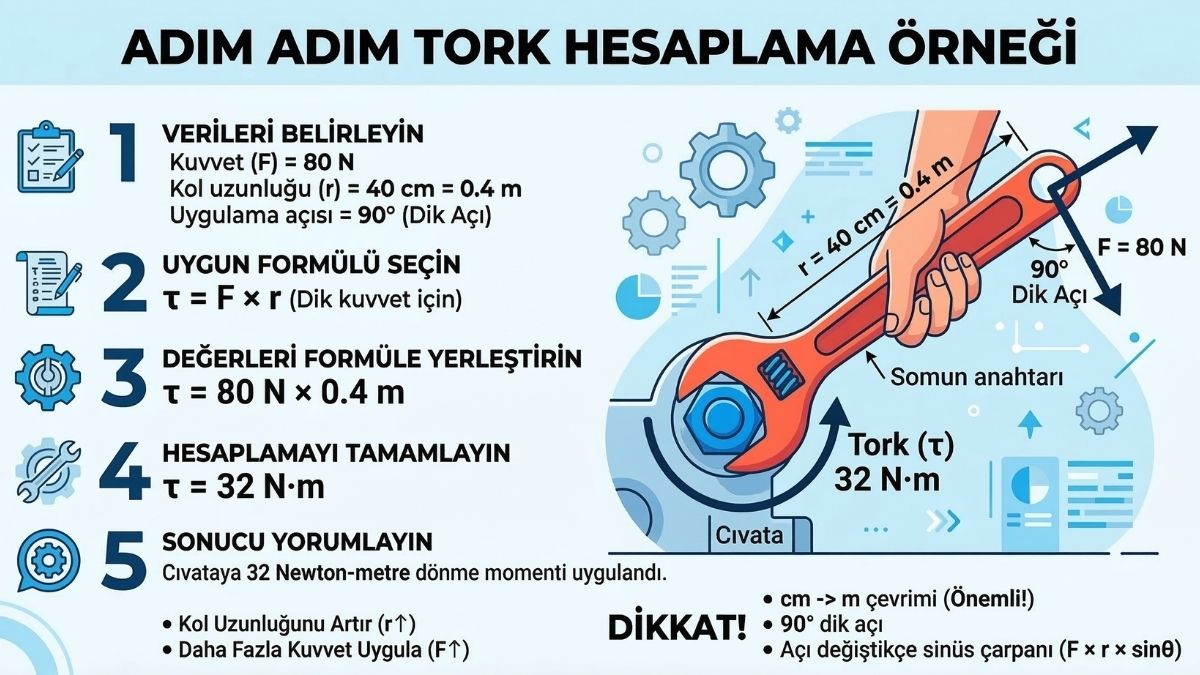
Instead of memorizing formulas, working through a concrete example makes the concept much more permanent. Now let’s consider a real-life scenario: You have a wrench that is 40 cm long, and you apply a force of 80 Newtons at the end of the wrench to loosen a bolt. Let’s calculate the resulting torque together.
1. Identify the data
Force (F) = 80 N
Lever length (r) = 40 cm = 0.4 m
Force application angle = 90 degrees (perpendicular)
2. Choose the appropriate formula
Since the force is applied perpendicular to the lever, the basic formula is sufficient: τ = F × r
3. Substitute the values into the formula
τ = 80 N × 0.4 m
- Complete the calculation
τ = 32 N·m
5. Interpret the result
You have applied a rotational moment of 32 Newton-meters to the bolt. If the bolt does not loosen at this value, you need to either increase the lever length or apply more force.
As you can see, the calculation is based on a simple multiplication. The critical point is to use units correctly. Length values given in centimeters must be converted to meters; otherwise, the result will be incorrect. Also, make sure the force is applied at a right angle. Remember that when the angle changes, you must include the sine factor in the formula.
What Does Engine Torque Mean?
Engine torque refers to the mechanical force produced by an internal combustion or electric motor to rotate the crankshaft. This value, which you frequently encounter in vehicle catalogs, indicates how strong a rotational moment the engine can generate. A motor that produces high torque provides strong acceleration even at low speeds. Therefore, trucks, off-road vehicles, and towing vehicles that carry heavy loads are equipped with high-torque engines. The instant response of electric vehicles is also directly related to their ability to reach maximum torque from zero speed.
When choosing a car, engine torque should be evaluated together with horsepower. While torque determines how the vehicle behaves during acceleration and on slopes, horsepower affects its ability to reach higher speeds. When you see a specification such as "250 N·m @ 1,500 rpm," it means that the engine produces 250 Newton-meters of torque at 1,500 revolutions per minute. Achieving maximum torque at low rpm provides comfort in city driving, while reaching it at high rpm indicates a sportier driving character.
Torque Unit Conversions (N.m, kg.cm, lb.ft)
.jpg)
Torque units vary across different countries and industries. The international standard Newton-meter (N·m) is widely used in scientific studies and the European market. The American automotive industry prefers the pound-foot (lb·ft) unit. In small-scale mechanical applications and hobby electronics, kilogram-centimeter (kg·cm) is commonly used. When reviewing technical documents or obtaining information from international sources, converting between these units becomes inevitable.
A fixed coefficient is used for conversion between Newton-meter and pound-foot. A value of 1 N·m is approximately equal to 0.737 lb·ft. Conversely, 1 lb·ft is calculated as 1.356 N·m. When you see a torque value of 300 lb·ft in an American vehicle catalog, you can interpret it as approximately 407 N·m.
The kilogram-centimeter unit is mostly preferred in servo motors, stepper motors, and robotic applications. 1 N·m corresponds to approximately 10.2 kg·cm. When you read that a small servo motor produces 15 kg·cm of torque, you should know that it is approximately 1.47 N·m in the SI system. This conversion is very useful in hobby projects such as model aircraft, RC vehicles, or 3D printers.
For practical calculations, it is sufficient to remember the basic conversion factors. Multiply by 0.737 to convert from N·m to lb·ft; use the factor 10.2 to convert to kg·cm. Although online calculators simplify this process today, understanding the logic behind the formulas allows you to interpret technical data quickly.
Common Mistakes in Torque Calculation
Although torque calculation is based on a simple formula, many people make similar mistakes in practice. Especially when unit conversions and angle factors are ignored, the results can be completely incorrect. Being aware of these mistakes helps you avoid serious problems in both theoretical and practical applications.
1. Calculating without unit conversion: Using lever length in centimeters directly in the formula is the most common mistake. In the SI system, distance must be entered in meters. If you do not convert 30 cm to 0.3 m, the result will differ by a factor of 100.
2. Ignoring the force angle: Force is not always applied perpendicular to the lever. If you do not include the sin(θ) factor in angled applications, the calculated value will appear higher than the actual torque. This can lead to serious design errors, especially in engineering projects.
3. Confusing torque with force: Torque is not a force; it is the rotational effect of a force. Applying 100 Newtons of force and producing 100 N·m of torque are completely different concepts. Calculations made without clearly distinguishing this will be fundamentally incorrect.
4. Measuring lever length incorrectly: The perpendicular distance from the axis of rotation to the point of force application must be measured. Taking an angled or total length distorts the result. This measurement must be done carefully, especially in complex mechanical systems.
5. Inconsistency between units: Mixing N·m, kg·cm, and lb·ft values within the same calculation is a common problem. All data must be converted into a single unit system before performing calculations.
Most of these mistakes can be prevented with careful preparation. Before starting the calculation, convert all data into the same unit system, determine the angle of force application, and measure the lever length from the correct points. Creating a simple checklist can protect you from potential issues, especially in critical projects.
