
Planetary Gear Reducer Working Principle and Application Areas
The planetary gear reducer is among the types of gear reducers. Planet gears consist of components such as the sun gear, ring gear, planet gears, and planet carrier. This reducer, used in areas where high speed and torque are very important, is also preferred in medical, aerospace, automotive, robotics, and heavy industry machines. These devices, which have a highly durable structure, feature low noise, high efficiency, and a compact design. This mechanical structure, which stands out in terms of its working principle, consists of multiple components and continues to provide significant advantages.
What Is a Planetary Gear Reducer?
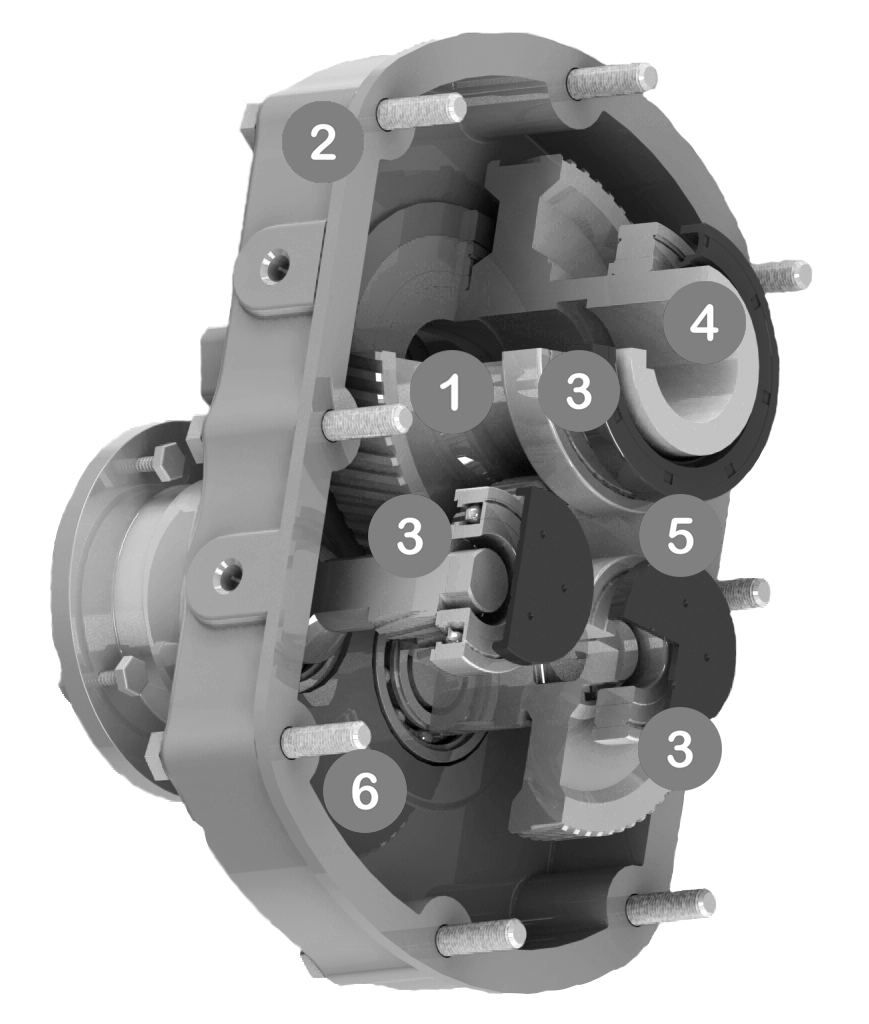
A planetary gear reducer is a special type of reducer with a compact and powerful structure that can achieve high torque values. It is named after the rotational motion of planets around the sun. Preferred in industries requiring high precision, this device delivers successful results in systems requiring speed reduction and torque increase. Its structure and components are as follows;
-
⚫ Planet Carrier: It is an important component that transfers the motion received from the sun gear to the ring gear via the planet gears. It is connected to the output shaft and generates the output motion.
-
⚫ Ring Gear: Also known as the ring gear. It surrounds the planet gears and is recognized by its ring structure forming the outer part of the system. It is always in interaction with the planet gears. The ring gear, which can also remain fixed, is sometimes connected to the output shaft and driven.
-
⚫ Planet Gears: These are small gears arranged symmetrically around the sun gear. Usually, there are 3 or 4 of them. They interact with the sun gear, receive rotation, and transmit power. During operation, they continue rotating between their own axes and the sun gear.
-
⚫ Sun Gear: It is the central gear. It is connected to the input shaft. It is the gear where power and torque are first received. It is also known as the motion center of the system.
Are Planetary Gear Reducer and Planetary Gearbox Different?
Planetary gear reducer and planetary gearbox are different applications. Although they are used interchangeably, both reducers have some different features and are preferred in different industries. First of all, the planetary gear reducer defines the entire planetary gear mechanism. It generally consists of components such as the ring gear, planet carrier, planet gears, and sun gear. While providing a very powerful gear system, it can meet different mechanical needs. However, it does not go beyond its basic function.
The planetary gearbox, on the other hand, is a term specifically emphasizing the gear system. It is the name given to the gear-based versions of the planetary reducer. This term is also used for the overall gear mechanism of the system. The planetary gear reducer is preferred in aerospace, medical devices, heavy industry, wind turbines, the energy sector, robotics, and the automotive industry. Similarly, the planetary gearbox is used in automotive and transportation, automation systems, medical devices, agriculture and forestry machinery, printing machines, and the food and beverage industry.
Planetary Gear Reducer Working Principle
The planetary gear reducer consists of multiple gears rotating around the sun gear and interacting with the ring gear that surrounds them. Information about its working principle is as follows;
-
⚫ The sun gear remains fixed. The ring gear begins to receive power from the input shaft, and the planet carrier provides output. Thus, the gears rotate around the ring gear. The resulting motion is transmitted to the planet carrier, providing high torque.
-
⚫ If the planet carrier is held fixed, the input continues through the sun gear. In this way, the ring gear moves. With the motion received from the sun gear, the ring gear begins to rotate.
-
⚫ If the ring gear remains fixed, the input continues through the sun gear, and the output is obtained from the planet carrier. This process is known as the most common working method. It provides low speed with high torque.
When we look at the basic features of the planetary gear reducer working principle, the planet gears in the reducer are always in contact with both the ring gear and the sun gear. This increases torque transmission. As a result, power loss is minimized. Torque increase and speed reduction are also among its working principles. Gear ratios generally vary between 3:1 and 100:1. In these systems where input and output are on the same axis, balance is always maintained.
Planetary Gear Reducer Application Areas
The application areas of planetary gear reducers are quite broad. Since they provide precise speed, high durability, and torque, they are preferred in different sectors. These sectors are;
- ⚫ Automotive: Used in transmission systems, steering systems, and electric vehicles where power transmission is required.
- ⚫ Automation and Robotics: Used in robotic equipment, transport systems, and industrial robots, where high-precision control is required.
- ⚫ Heavy Industry: Used in excavators, chain transport systems, loaders, and cranes.
- ⚫ Space and Aerospace: Frequently used in satellite systems and aircraft wing mechanisms.
- ⚫ Renewable Energy Systems: Preferred in wind turbines, hydroelectric power plants, and solar energy systems.
- ⚫ Medical Devices: Used in dental equipment, surgical robots, and rehabilitation devices.
- ⚫ Agriculture and Forestry: Used in harvesters, tractors, and collection equipment.
- ⚫ Printing and Packaging: Preferred in packaging and printing machines.
- ⚫ Marine and Maritime: Frequently used in lifting cranes and ship propellers.
In addition, these systems are also used in mining, metallurgy, and the food and beverage industry. Planetary gear reducers provide precise motion capability for applications such as mixers, crushers, furnaces, conveyor systems, as well as filling and labeling lines.
What Are Planetary Gear Reducer Prices?
Planetary gear reducer prices vary depending on gear ratios, torque capacity, model, application areas, production materials, and brand. Generally, standard, low-power systems with standard gear ratios are more affordable. However, specially designed systems with high torque and high precision requirements may be more expensive. In other words, there are price differences between planetary gear reducers used in small automation systems and those preferred in heavy industry machines.
Advantages of Planetary Gear Reducers
These systems are generally preferred in many industries due to their efficiency, compact structure, and high torque capacity. In these systems, which can be easily used in confined spaces, there is extensive contact between the gears. This minimizes power loss. Efficiency values generally range between 95% and 98%. Planetary gear reducers, which provide high durability and operate for long periods without maintenance, offer low noise and vibration advantages. Due to their structure, they operate with very low vibration, making them suitable for precision systems.
Planetary gear reducers have high torque capacity. Compared to other systems of the same size, they provide higher torque and offer different reduction ratios. Designed for both high-speed and low-speed applications, these reducers meet the needs of various industries. They are used in a wide range of fields from automotive to medical devices, from heavy industry to robotics. In addition, thanks to their axial symmetry advantage, they have a balanced structure. That is, input and output are on the same axis, ensuring balanced power transmission.
Planetary Gear System and Structural Features
The planetary gear system consists of three main components: a central gear called the sun gear, gears rotating around it, and an outer gear surrounding them. Its structural features are as follows;
-
⚫ Central Gear: It is the main gear where power input is provided and is located at the center of the system. Other gears rotate around the central (sun) gear and receive motion. It is connected to the input shaft. Its main function is to control the torque and speed of the system.
-
⚫ Planet Gears:They rotate around the central gear. They consist of three or more gears and are responsible for power transmission between the ring gear and the sun gear.
-
⚫ Ring Gear:Also known as the ring gear. It surrounds all the planet gears. It is located on the outer part of the system and is fixed, although in some cases it can be moved.
-
⚫ Planet Carrier:It carries the planet gears and keeps them fixed. It can sometimes be connected to the output shaft, thus playing a role in transmitting motion outward.
Things to Consider When Selecting a Planetary Gear Reducer
There are several factors to consider when selecting a planetary gear reducer. These include noise level, maintenance requirements, price, ease of use, material structure and quality, and operating environment conditions. In addition, the selection should be based on precision and positioning requirements. For example, in sectors such as automation and robotics where precision is critical, low-backlash models are preferred. At this stage, compactness and size are also important. The size should be suitable for the application area. Working load, speed ratio, and torque requirements should also be considered during selection.
The main function of a planetary gear reducer is to increase torque. Therefore, it is important to determine the required maximum torque value. If a reducer is selected below the required torque capacity, the equipment will be strained and its service life will be shortened. Reduction, that is, the speed ratio, is also among the important criteria. The speed ratio is the difference between input and output shaft speeds. Proper adjustment of this ratio ensures a balance between the desired speed and torque. In addition, higher efficiency means lower operating costs and less energy loss. Therefore, for applications with long operating durations, high-efficiency reducers should always be preferred.
Maintenance and Service Processes of Planetary Gear Reducers
Regular maintenance and servicing are required for the system to operate efficiently. These are important to prevent failures, minimize performance losses, and ensure the healthy operation of the reducer. First, the quality and type of oil used in the reducer should be checked. The oil must be replaced periodically. Additionally, the oil level should be monitored regularly. Insufficient lubrication causes gear wear.
Cleaning is also very important. There should be no dirt, dust, or foreign substances on the outer surface of the reducer. Cleaning, which reduces wear and increases efficiency, should also be carried out on internal components. During cleaning, attention should be paid to oil residues and contamination. During maintenance, sealing checks should also be performed. Gaskets and other components should be checked regularly. Damaged or worn sealing elements should be replaced, and oil leaks should be inspected. While doing all these, gear and shaft inspections should be carried out to examine wear conditions.
While the reducer is in operation, it should be checked for abnormal sounds. Sounds such as humming or buzzing may indicate damage to gears or other components. Similarly, vibration during operation may indicate a malfunction in a specific area. While checking screws and nuts, mounting surfaces should also be inspected. Necessary corrections should be made promptly. Finally, professional support should always be sought for maintenance and service processes, as these procedures require technical knowledge and experience.